

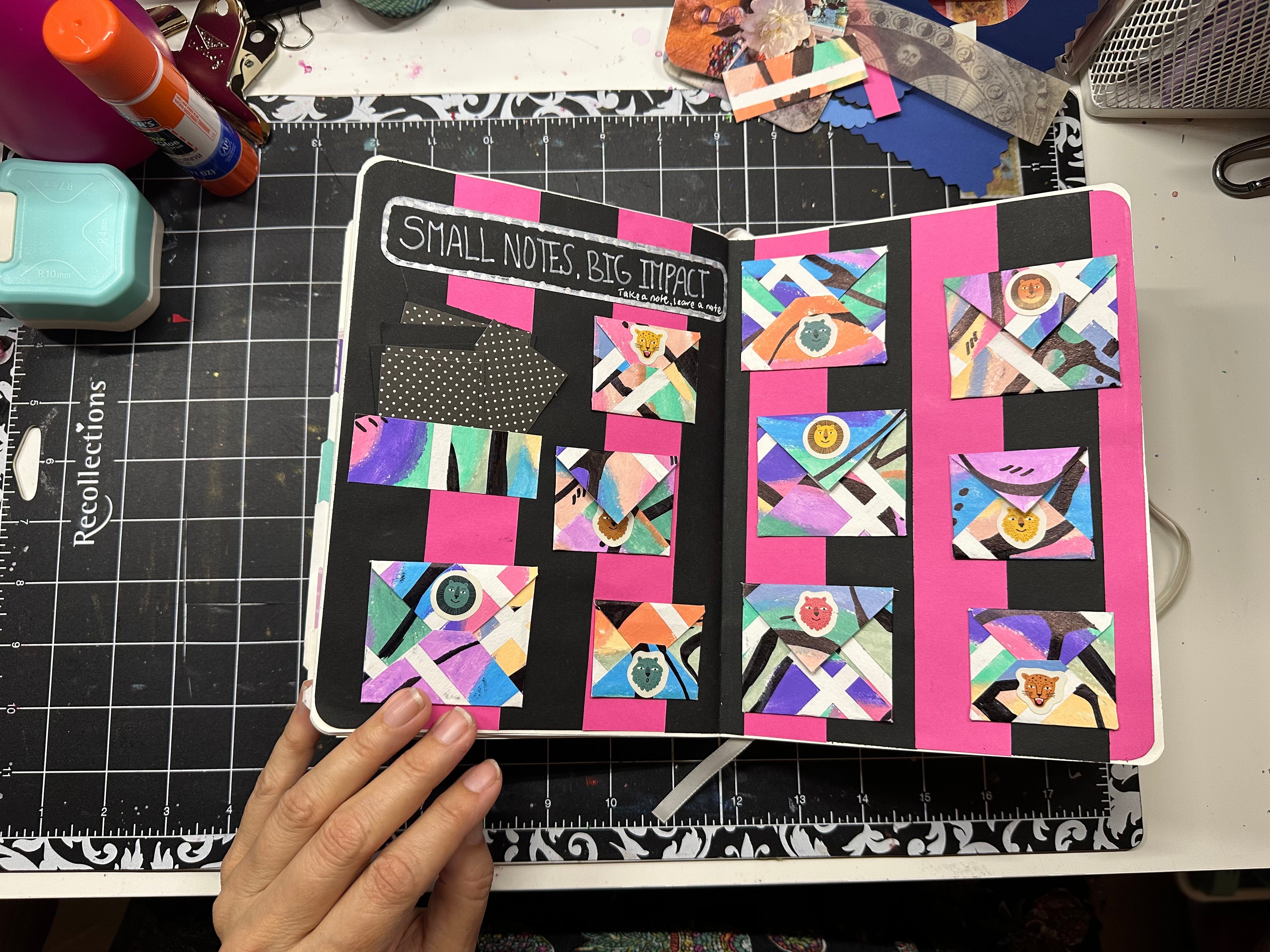
One of the questions I get most often from women who are just starting out is some version of: what do I actually need?
It's a fair question. The stationery and art supply world is vast and genuinely fun to get lost in, but it can also feel overwhelming when you're standing at a starting line and you're not sure what direction to run.
So here's my answer, built from years of filling journals and obsessing over supplies: you need less than you think, and the things that matter most are probably simpler than you'd expect.
(If you’re interested, I’ve assembled a limited number of starter kits with some of my favorite items and a few things from my personal stash.)

A Softcover Notebook
The notebook is the foundation, so let's start here. My strong recommendation for beginners is a softcover notebook with blank or dot grid pages.
The softcover lays flat easily and will flex as your journal fills up. The dot grid gives you just enough structure to write in a straight line or sketch a rough border, while staying completely out of the way visually.
In terms of size, I would start with an A5 size, or roughly 5.5 inches wide by 8.5 inches tall. This is an intermediate size to use until you figure out if you prefer smaller or larger pages.
Brand matters less than format here. Find one that feels good in your hands, is priced in a range you're comfortable filling up, and has pages thick enough to handle a little glue. The rest is personal preference and vibes.
A Glue Stick
A staple in my personal kit is the Elmer's glue stick (the purple one that goes on purple and dries clear) because it is great for almost anything you might want to stick in your journal. This is not sponsored.
A Good Pair of Scissors
Once you start gathering materials to work with, scissors become a tool you will reach for constantly. You’ll want something sharp, comfortable to hold, and dedicated to your journal practice. Pro tip: Keep them separate from the kitchen scissors, the gift wrap scissors, and the everything-else scissors. Your creative space deserves its own tools.
Things That Make Marks
Choosing from pens, markers, pencils, inks, etc., can be daunting. In my view, the thing to consider now is whether you will need something to be waterproof or not. Waterproof means that you will be able to put paint or glue over it after the fact, without it smearing. That comes down to what you want to make and how. Because I love to play with watercolor paints, I tend to stick with waterproof pens like Sharpies.
For things I’ll be adding as later layers, I love to reach for acrylic paint pens or Gelly Roll (gel) pens. Both options come in a great range of colors, write smoothly on most textures, and work for both writing out your thoughts and adding small drawn details to a page. (Again, this is not sponsored.)
Together, a set of waterproof pens and a few gel or acrylic ones will cover almost everything you'd want to do on a page. Pro tip: Start with colors you're genuinely drawn to, not a set that feels like it “should” appeal to you.
Pieces and Scraps
Start collecting. Leftover wrapping paper, paper bags with a pretty pattern, pages torn from old magazines or catalogs, tissue paper from a gift, a napkin with an interesting texture, a postcard, a calendar page. All of it is fair game.
Creative journaling is deeply personal, and the materials you choose to include are part of that. A torn piece of paper from a trip, a receipt from somewhere meaningful, a piece of color paper pulled from a brand you love. These small things carry more weight on a page than anything you could buy.
Keep a little stack somewhere accessible. Add to it whenever something catches your eye. You'll reach for it more than you expect. Pro tip: Sort through your stash regularly and let go of items you are less excited about.
Stickers
And finally: stickers. Yes, really. (Washi tape counts here, too)
I gravitate toward florals these days, but the only rule here is that you reach for the ones you feel something for that day. Stickers are one of the fastest ways to make a page feel finished and intentional.
They also carry a little joy! The right sticker on the right page, placed exactly where it belongs, is deeply satisfying. Buy the ones that make you feel something. Pro tip: Use them.
A Note on What's Not on This List
You'll notice there's no paint, no ink, no stamps, no scrapbook paper, no specialty tools. I’m also not touching on the idea of a collection of journals or “a journaling ecosystem” as it’s sometimes called. Those things are wonderful for their own reasons, and you may well find your way to all of them in time.
That said, your creative journaling practice can absolutely start with a notebook, a glue stick, some scissors, a few pens, things you've collected, and stickers you love. The focus of the moment is trial and exploration, so that you can find out what works for you and what will keep you coming back to your practice.
So, get those six things together, sit down and see what happens. I’m rooting for you.


